
Meet our people: Dr. Michelle Egan-Bitran
Lead researcher, former programme advisor New Zealand and Pacific
Family For Every Child’s work would not be possible without our member organisations, our Boards, advisors, and a small but mighty team who work to keep our alliance connected and guide our collective work. One of these people is Michelle Egan-Bitran, Family’s lead researcher and former programme advisor for New Zealand and Pacific. We sat down with Michelle to gain insights into the work that she has done to connect our local collective here in Aotearoa.
Without further ado…
Kia ora Michelle, what has been your role at Family?
As the lead researcher and programme advisor, I worked with local civil society organisations on monitoring children’s rights in Aotearoa New Zealand and on improving outcomes for all children. Civil society organisations (CSO) are non-governmental, non-profit groups that bring people together to support a common cause, serve the public good, or advocate for change. In New Zealand, we have a lot of amazing organisations doing incredible work that we’ve partnered with to progress this work.
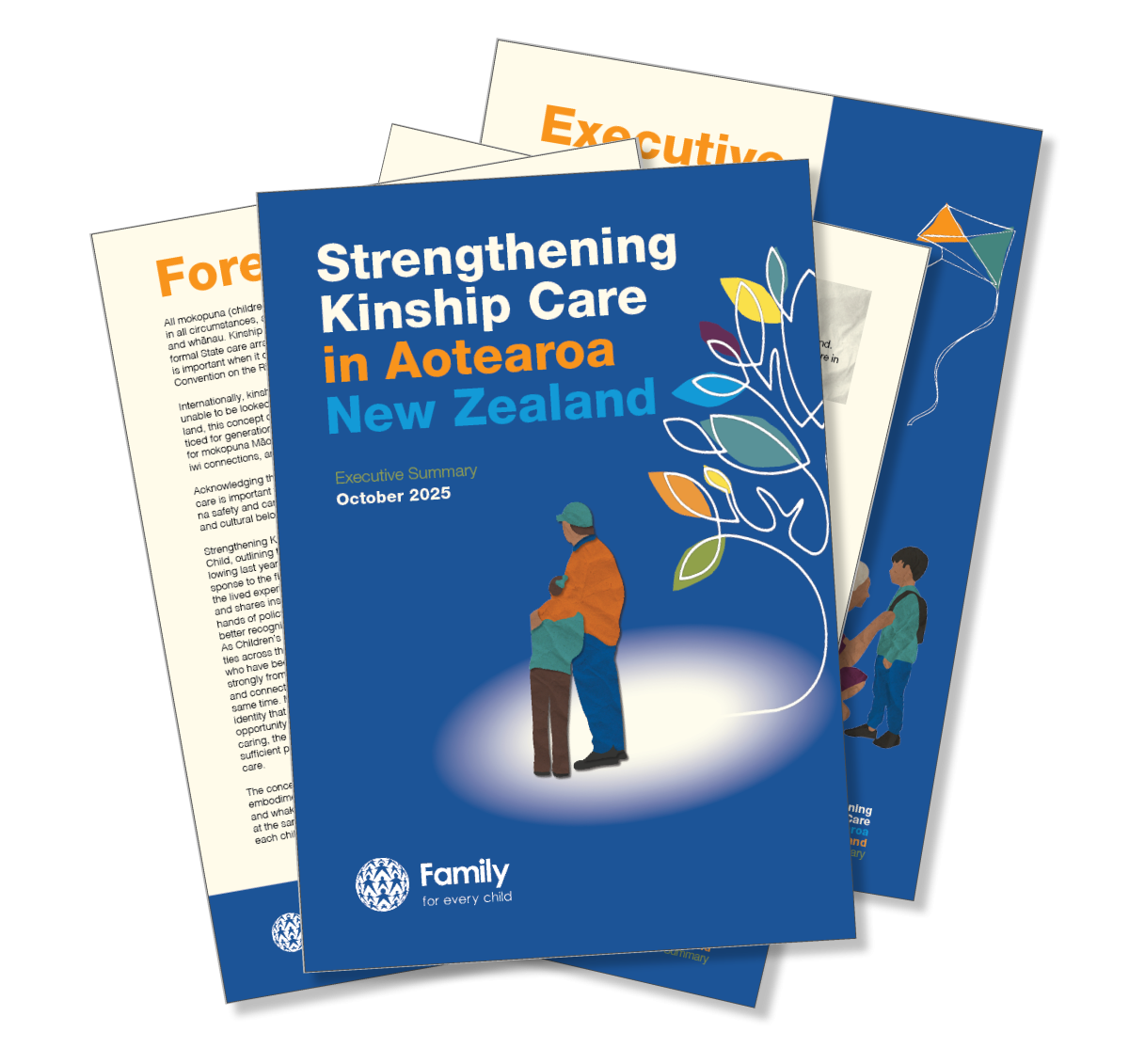
I was fortunate enough to project manage and co-lead research with Dr. Braden Clark, an advisory groups and community partners to design and carry out research on Strengthening Kinship Care in Aotearoa New Zealand.

Read our 2025 research on kinship care in Aotearoa, led by Michelle in collaboration with Dr. Braden Clarke
Michelle, tell us more about yourself, what’s your background?
I was born and raised in Ōtepoti/Dunedin and now live in Tāmaki Makaurau/Auckland with my three daughters. As a qualified social worker, I have over 25 years’ experience in the social sector. Personal integrity, respect, and care are central to who I am and how I work.
Before my time at Family, my work included monitoring Oranga Tamariki, working at Office of the Children’s Commissioner [Mana Mokopuna], teaching and researching at the University of Auckland Faculty of Counselling, Human Services and Social Work. I completed my doctoral thesis in 2022 titled Gremlin of Silence: Exploring the New Zealand Catholic, Methodist and Presbyterian Institutional Responses to Interpersonal Violence, you can read it here.
Following on from this I was a Principal Advisor at the Abuse in Care Royal Commission of Inquiry which revealed the dark sides and failures of New Zealand’s care system, with its findings and recommendations helping to shape the work of Family For Every Child in Aotearoa, and the research that I delivered alongside Dr. Braden Clark, an advisory groups and community partners. I have also worked as a consultant at Safeguarding Children and am now working as the Strategic Lead for Te Ohu Kitenga, the Family / Whānau Violence Waitematā Governance and Strategic Leadership Group, where I am working with organisations and government agencies across Waitematā, to improve how we respond to family violence, including sexual violence, child abuse, and neglect.
What inspires you most about your job?
I am inspired by a desire to see children, families, whānau and communities thriving. All children and tamariki need love, guidance and support from their families and whānau, opportunities to play and be with friends, and to be valued as part of their communities. They also need to be treated with respect and be listened to.
Our research was guided by a group of advisors and local organisations that I felt very honoured to work with, and I know our work can have real impact to help protect children, and wrap around them and their carers so that they can heal, thrive and actually live a good life.
“I love that Family For Every Child is committed to being led by, and working collaboratively with local organisations and leaders. Our work is developed through actively listening to carers, children, their whānau, hapū, iwi and the communities and groups impacted by the issues that we are working to address.”
– Dr. Michelle Egan-Bitran
What are the most pressing challenges that vulnerable tamariki and rangatahi in New Zealand are facing?
Oh, there are so many! That’s exactly why we do this work. Overall, we need systems, a society and all of us to prioritise ALL children’s safety and wellbeing. Everyone has a role to play. We know for example that child abuse, neglect and child homocide is preventable. Together we need to stand and collectively call for greater respect, protect and care of children and their rights – that includes tāmariki Māori and their right to a cultural identity and connection to whānau and whenua.
As New Zealanders we need different ways of working. We need a national joined up, integrated child abuse and neglect prevention and intervention strategy, with action taking place across all government sectors, Iwi and community groups. We need to work as a collective. We all have a role to play to prevent violence and child abuse, and when it does occur, to identify it quickly and respond to minimise harm.
As our global and local research on kinship care, as well as international children’s rights and international rights bodies and alliances show, kinship care has an important role to play. It is part of the solution but it needs to be better supported.
I spoke to Radio New Zealand about this – you can listen to my conversation with Amanda Gillies, and read the article, below.


How does Family’s work help to fight these challenges?
Family for Every Child are part of a collective movement for change. We have collaboratively been leading areas with our partners, around supporting and strengthening kinship and whānau care, and calling for a national strategy and action plan to prevent child abuse, neglect and child homicides. A lot of this mahi (work) involves connecting local changemakers with one another. By forming this network, we can support the sharing of local knowledge and practice, enabling a bigger, collective impact.
Another part of my role here was to connect local stakeholders and organisations in Aotearoa with other member organisations of the Family for Every Child alliance across the globe. Through this global network, we support thousands of children and families by taking locally-led action in our communities.
Where is Family’s programme in New Zealand heading in 2026?
In 2026, there is a real chance to build on the important groundwork we achieved through our collective research into the role of kinship care in Aotearoa New Zealand. Completing this research, sharing it across the sector and with the media revealed two key priorities for 2026: Kinship carers need better support, and New Zealand needs a cross-sector strategy to prevent child abuse and support all families at the community level. This, in turn, will help keep more children safe. A strategic plan for making this happen is key to bringing abuse rates in all care settings down. We need to do it for the children, and we need to work together.
Our collective advocacy work will focus on these key issues. We will aim to continue providing robust evidence to advocate for system reform that prioritises, supports and enables whānau-based care and prevents violence, meaning that more children will be safer, culturally connected and protected in the future.
Locally, how will this work impact vulnerable rangatahi and tamariki in the long term?
If the research is integrated into legislative review, policy design and practices, it will help ensure that more children are kept safe, that they and their kinship carers are supported so that children and families can heal and live good lives. This means, we hope to provide a significant contribution to proactive safeguarding of children and the building of stronger, safer and better child protection systems in Aotearoa. It’s about collective care and getting everyone in the sector to work together to prevent child abuse and keep families and whānau connected, with the right support in place to allow more children to thrive.

Read about our work in 2025 to get more details

Or go directly to the research report below
“It’s whānau just all supporting each other and stepping in when you have to so that it doesn’t get any worse and trying to do our best for the children.”
– Research participant, Strengthening Kinship Care in Aotearoa New Zealand
Policies
Connect

2025 Family for Every Child New Zealand Trust | Registration no. CC54645 | Company no. 2670471
2025 Family for Every Child is a charitable company limited by guarantee | Registered charity in England and Wales no. 1149212 | Company no. 08177641
2025 Family Alliance Inc. | Family Alliance is a 501(c)(3) non-profit organisation registered in NYS | EIN 46-5518730
